
Eliminate Risks of Exogenous Contamination
100% recombinant proteins, no animal-derived or human-derived materials.Eliminates contamination risks from prions, hepatitis viruses, HIV and other pathogens.
Ensure Batch-to-Batch Consistency
Recombinant protein manufacturing ensures constant composition across batches, avoids lot variation from blood-derived raw materials, and guarantees process reproducibility.
Accelerate Regulatory Filing
Well-defined chemical components with clear traceability reduce difficulties in CMC review and shorten timelines for IND/BLA submissions.
| Product Name | Pack Size | Storage | Shelf Life | Cat. No. |
|---|---|---|---|---|
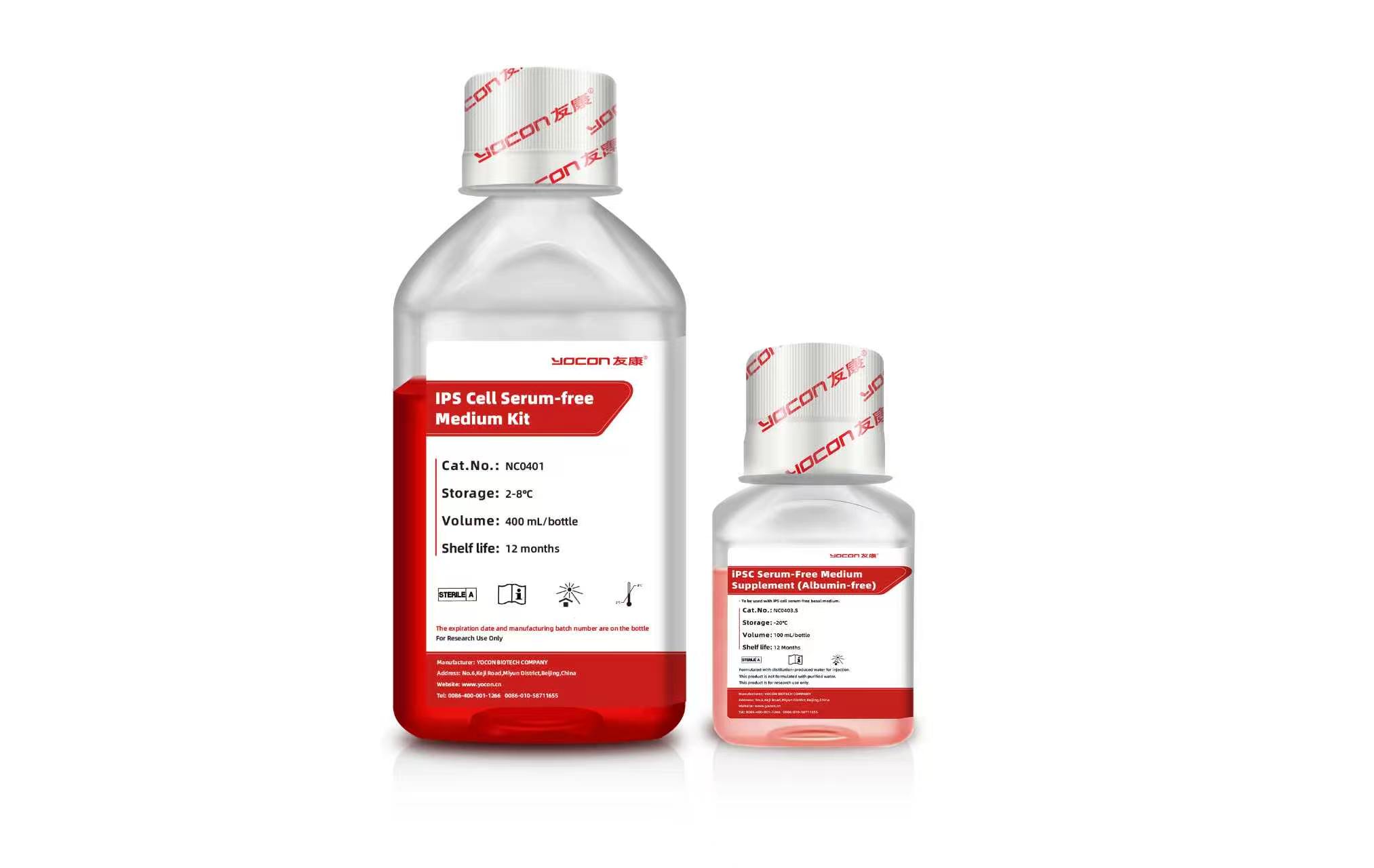
| iPSC Serum-Free Medium Base | 400mL/bottle | 2–8 ℃, protected from light | 12 months | NC0401 |
| iPSC Serum-Free Medium Supplement (rHSA) | 100mL/bottle | -20 ℃, protected from light | 12 months | NC0402.S |
Product Advantages
High-efficiency expansion: 21–30-fold expansion within 4 days for 2D culture; 6.6–10.25-fold expansion within 3 days after stabilized serial passaging in 3D culture. Proliferation performance outperforms comparable imported products and greatly shortens production cycles.
Sustained pluripotency: After long-term passaging, positive rates of TRA-1-60 and OCT4 remain ≥ 98%, and SSEA4 reaches 100%. Cells show typical morphology with no differentiation observed, ensuring stable downstream workflows.
Suspension compatible: Ready-to-use 3D suspension formulation. No extra recombinant protein supplement required. Simplifies workflows, reduces contamination risks, readily adapts to large-scale industrial culture and supports mass production translation.
Performance Data
2D (Monolayer) Culture
Cell Morphology
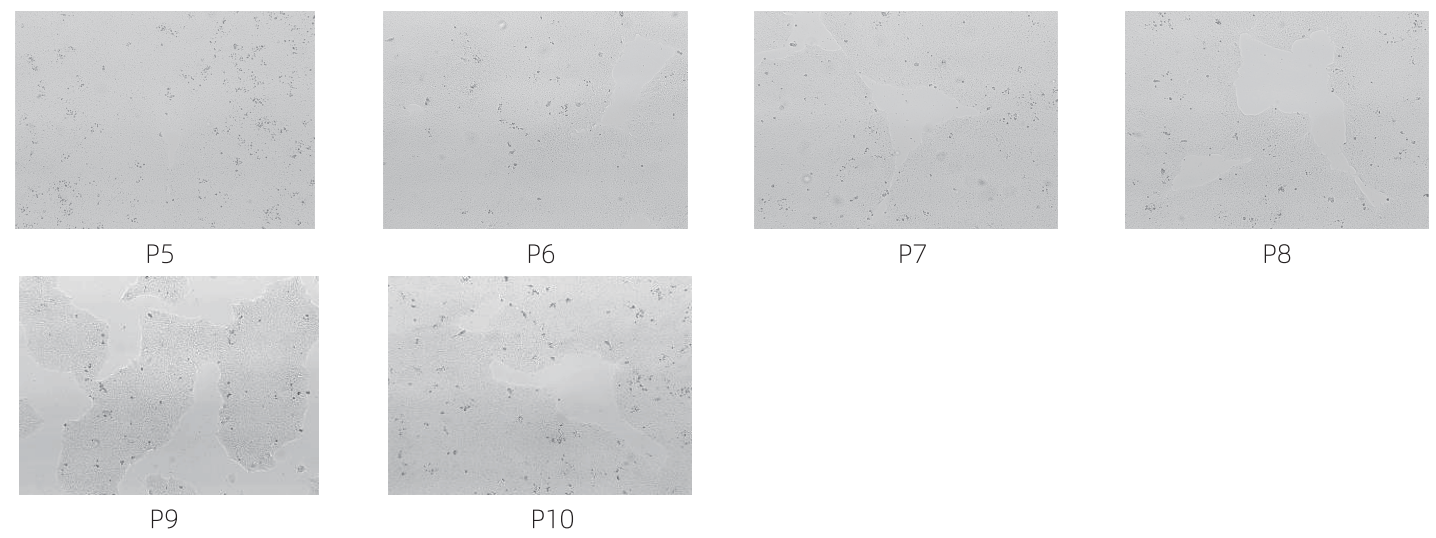
Cells exhibit typical iPSC colony morphology with sharp colony edges, high nucleus-to-cytoplasm ratio and no signs of differentiation.

2. Cell Proliferation Capacity
Within a 96-hour growth period, the fold expansion of serial passaging (P1-P10) is stably maintained between 21 and 30 folds.
| Passage | Seeding Density /cm² | Medium Volume (mL) | Harvested Cell Count | Fold Expansion | Culture Duration |
|---|---|---|---|---|---|
| P1 | 15600 | 2 | 3.31E+06 | 22.06 | 4 days |
| P2 | 15600 | 2 | 4.07E+06 | 27.12 | 4 days |
| P3 | 15600 | 2 | 3.17E+06 | 21.14 | 4 days |
| P4 | 15600 | 2 | 4.12E+06 | 27.48 | 4 days |
| P5 | 15600 | 2 | 3.95E+06 | 26.33 | 4 days |
| P6 | 15600 | 2 | 3.63E+06 | 24.25 | 4 days |
| P7 | 15600 | 2 | 3.85E+06 | 25.68 | 4 days |
| P8 | 15600 | 2 | 4.37E+06 | 29.14 | 4 days |
| P9 | 15600 | 2 | 3.73E+06 | 24.86 | 4 days |
| P10 | 15600 | 2 | 3.93E+06 | 26.22 | 4 days |
3. Stemness and Pluripotency Maintenance
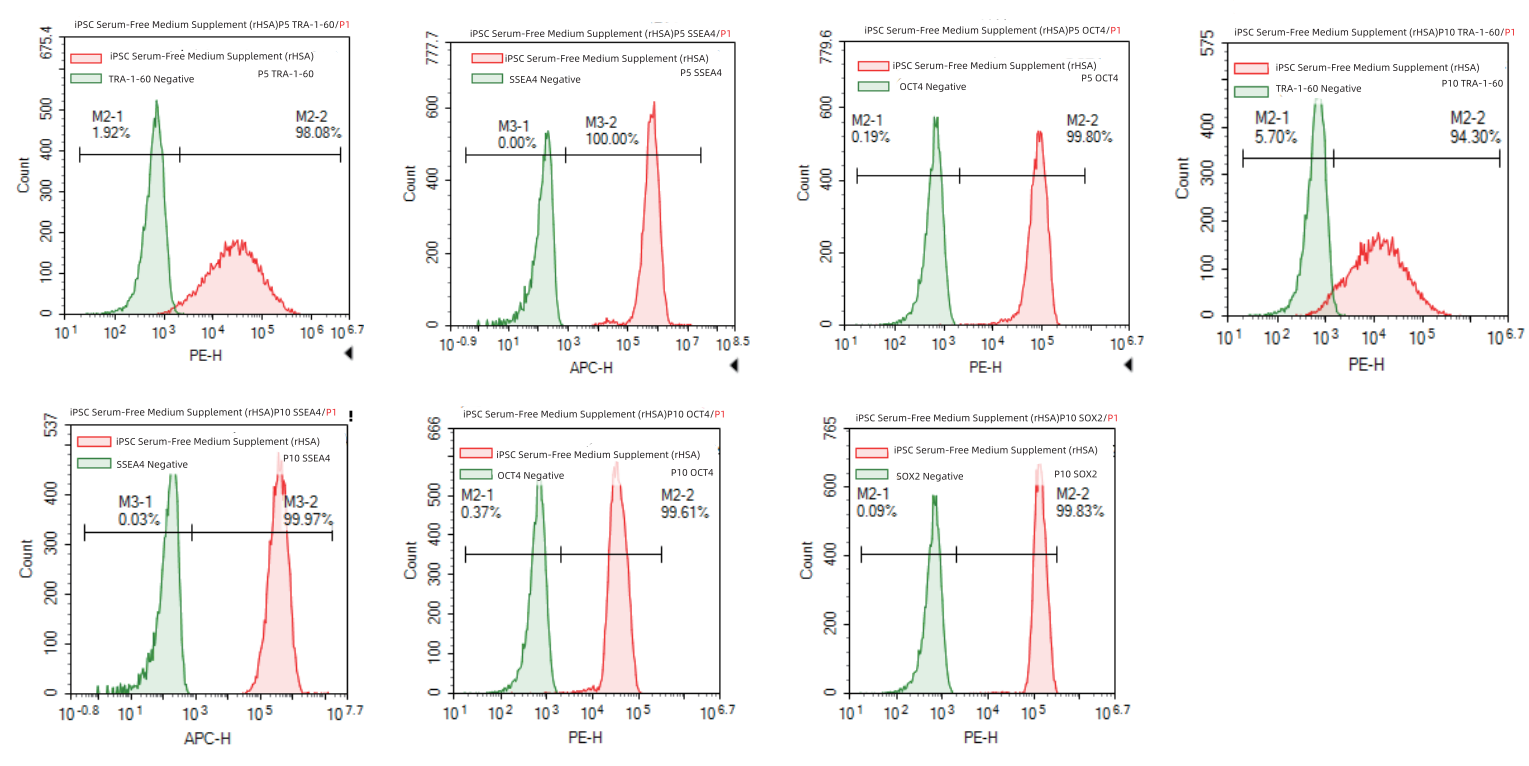
Under 2D culture conditions, P5 cells show a TRA-1-60 positive rate of 98.08%, SSEA4 positive rate of 100%, and OCT4 positive rate of 99.8%.
For P10 cells, the positive rates of stemness markers are: TRA-1-60 at 94.3%, SSEA4 at 99.97%, OCT4 at 99.61%, and SOX2 at 99.83%.
Suspension (3D) Culture
1. Cell Morphology
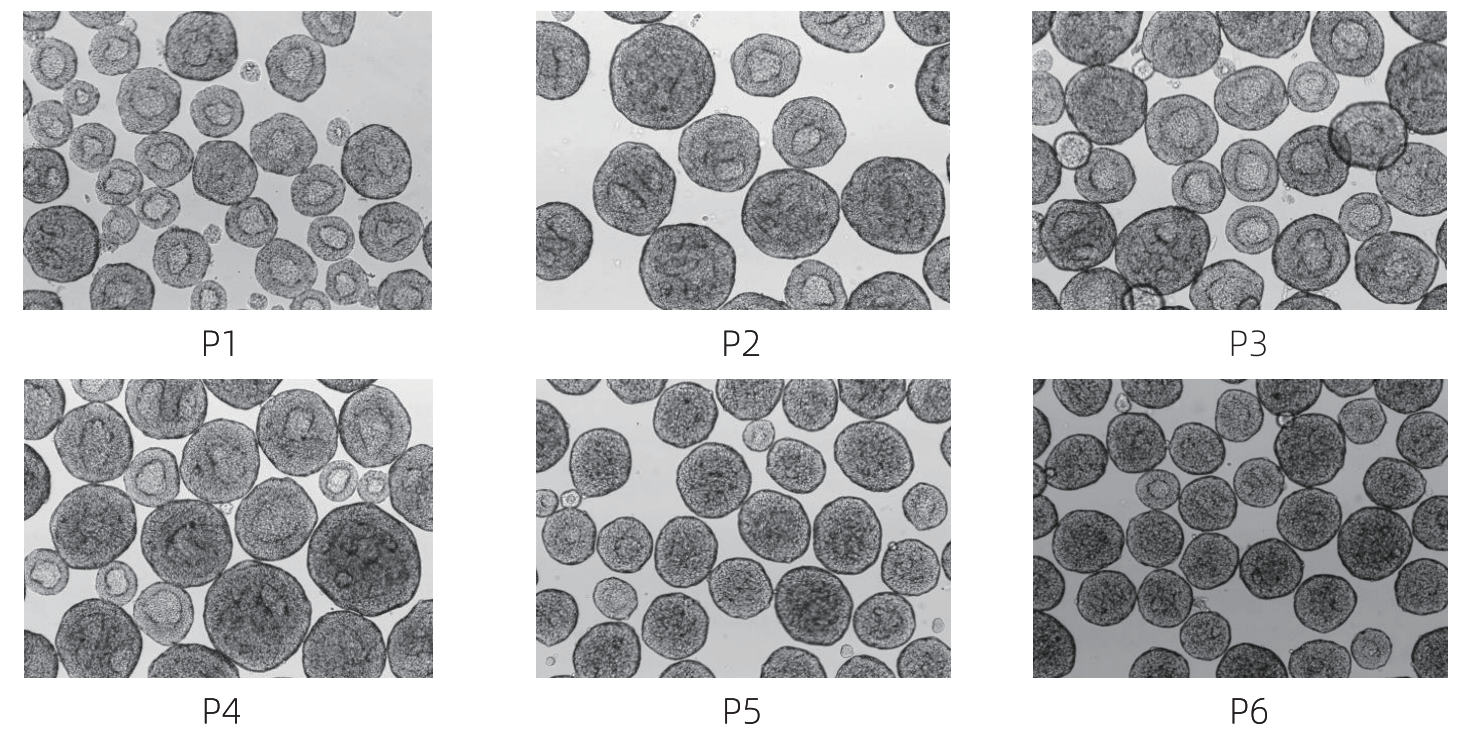
Uniform cell spheroids with smooth peripheries and good cell viability, suitable for suspension expansion.
2. Cell Proliferation Capacity
After a short adaptive phase post-thawing, high-efficiency expansion of 6.6 to 10.25 folds can be achieved within 3 days under stable serial passaging.
| Passage | Seeding Density | Medium Volume (mL) | Harvested Cell Count | Fold Expansion | Culture Duration |
|---|---|---|---|---|---|
| P1 (Thawing) | 100000/mL | 2 | 6.33E+05 | 3.16 | 3 天 |
| P2 | 100000/mL | 1.32E+06 | 6.6 | ||
| P3 | 100000/mL | 1.41E+06 | 7.05 | ||
| P4 | 100000/mL | 2.05E+06 | 10.25 | ||
| P5 | 100000/mL | 1.66E+06 | 8.3 |
3. Stemness & Pluripotency Maintenance
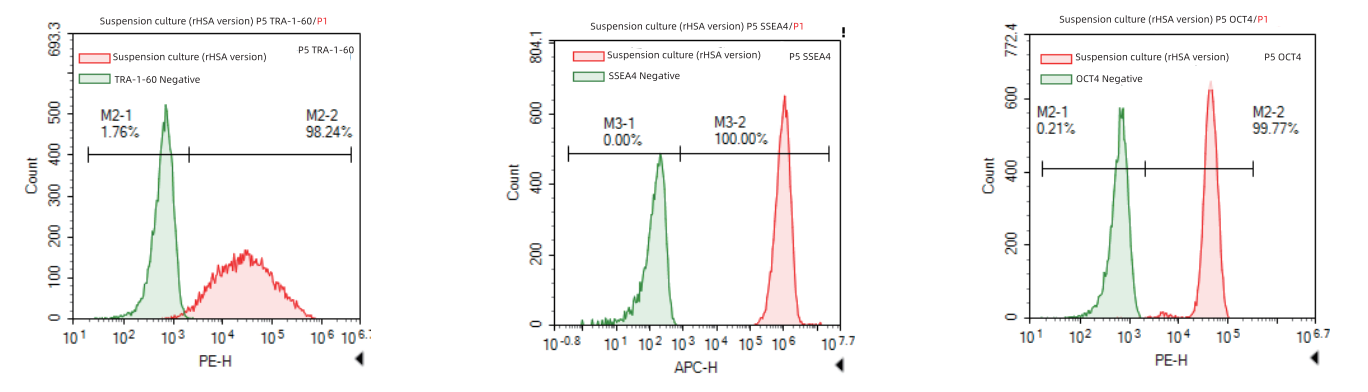
In 3D suspension culture, P5 cells: TRA-1-60 98.24%, SSEA4 100%, OCT4 99.77%.
Request samples & technical validation reports to accelerate your iPSC cell therapy clinical translation


